Vending Machine Trends 2026: What's Shaping the Industry
The vending industry has changed more in the last five years than it did in the previous twenty. What used to be a simple coin-operated box with chips and soda has evolved into a technology-driven, health-conscious, data-informed part of the modern workplace. If you are a business owner, facility manager, or property manager considering vending services, understanding where the industry is headed will help you make a smarter decision.
This guide breaks down the biggest vending trends shaping 2026, what each one means for businesses considering vending, and how to future-proof your vending setup so it does not feel outdated in a couple of years.
Trend 1: Cashless Dominance
The Shift:
Cashless payments now account for the clear majority of vending transactions. NAMA reports that cashless transactions represent the majority of all vending sales nationwide, a figure that has roughly doubled over the past five years. The shift has been steady and dramatic over the past few years, and in 2026 it has reached a tipping point where cash-only machines feel genuinely outdated.
What This Means in Practice:
- Mobile payment (Apple Pay, Google Pay) is expected by users, not treated as a bonus feature
- Credit and debit card tap-to-pay is the most common payment method across most vending locations
- Transactions are faster, which reduces lines and wait times during busy break periods
- Cash handling costs disappear. No coin jams, no bill validator issues, no counting cash during service visits.
- Operators get better sales data because every cashless transaction is tracked and logged
What This Means for Your Business:
If you are getting a vending machine installed in 2026 and it does not accept cashless payments, you are already behind. Any reputable vending provider should be offering machines with full contactless payment capability as standard. At Fast Fuel, every machine we install supports Apple Pay, Google Pay, and credit/debit card tap.
The days of keeping a jar of quarters at the front desk for employees who want to use the vending machine are over. If your current provider still runs cash-only machines, it may be time for an upgrade.
I have seen this shift play out in my own business. When I first got into vending, most machines were still cash-only and the product selection was basically chips, candy, and soda. That was what people expected, and that was what operators stocked. Fast forward to today, and the majority of our transactions are cashless. People tap their phone or their card and keep moving. But the product side has changed just as much. Clients regularly ask me for protein bars, kombucha, and sparkling water before I even suggest them. A few years ago, I would have had to convince people that those items would sell. Now it is the opposite. The shift has been dramatic, and it lines up with everything the industry data is showing. The vending machine of five years ago and the vending machine of today are almost two different businesses.
Trend 2: Health-Forward Options
Consumer Demand:
The demand for healthier vending options has been building for years, and it has now reached a point where most workplaces expect at least a meaningful selection of health-conscious products. The International Food Information Council (IFIC) found that over 70% of consumers actively consider healthfulness when purchasing packaged foods and beverages. This is not just about having one sad granola bar in the corner of a machine full of candy.
What "Healthy Vending" Actually Looks Like in 2026:
- Protein-rich snacks as a standard category, not an afterthought (protein bars, jerky, nuts, protein cookies)
- Organic and natural products from brands like KIND, RXBar, and Clif that have become mainstream
- Low-sugar and sugar-free alternatives across beverages and snacks
- Plant-based products for the growing number of consumers who prefer them
- Functional beverages including kombucha, enhanced waters, and drinks with added vitamins or electrolytes
- Clear nutritional labeling and calorie information visible on the machine or its digital display
How This Plays Out by Location Type:
- Offices: Employees increasingly expect healthy options. Companies that invest in workplace wellness programs want their vending to align with those values.
- Gyms: Healthy products are the entire point. Standard vending products are inappropriate for fitness environments.
- Warehouses: Workers need energy and protein for physical labor, which naturally skews the product mix toward healthier, more substantial options.
- Apartments: Residents want variety, including both comfort snacks and healthier alternatives.
What This Means for Your Business:
When evaluating a vending provider, ask about their healthy product selection. A good provider should be able to offer a balanced mix that includes both traditional favorites and health-conscious options, tailored to your specific environment.
Trend 3: Fresh Food Expansion
Beyond Snacks:
Fresh food vending and micro-markets have moved from novelty to standard offering. The combination of better refrigeration technology, improved supply chains, and consumer demand for real meals (not just snacks) has pushed this trend forward significantly.
What Fresh Food Vending Looks Like Now:
- Refrigerated machines that reliably maintain food-safe temperatures and display fresh items with clear expiration dates
- Sandwiches, wraps, and salads that are actually good, not the sad, plastic-wrapped sandwiches of ten years ago
- Microwaveable meals for workplaces where employees need a real lunch option
- Fruit cups, yogurt parfaits, and other items that would have been impossible in older machines
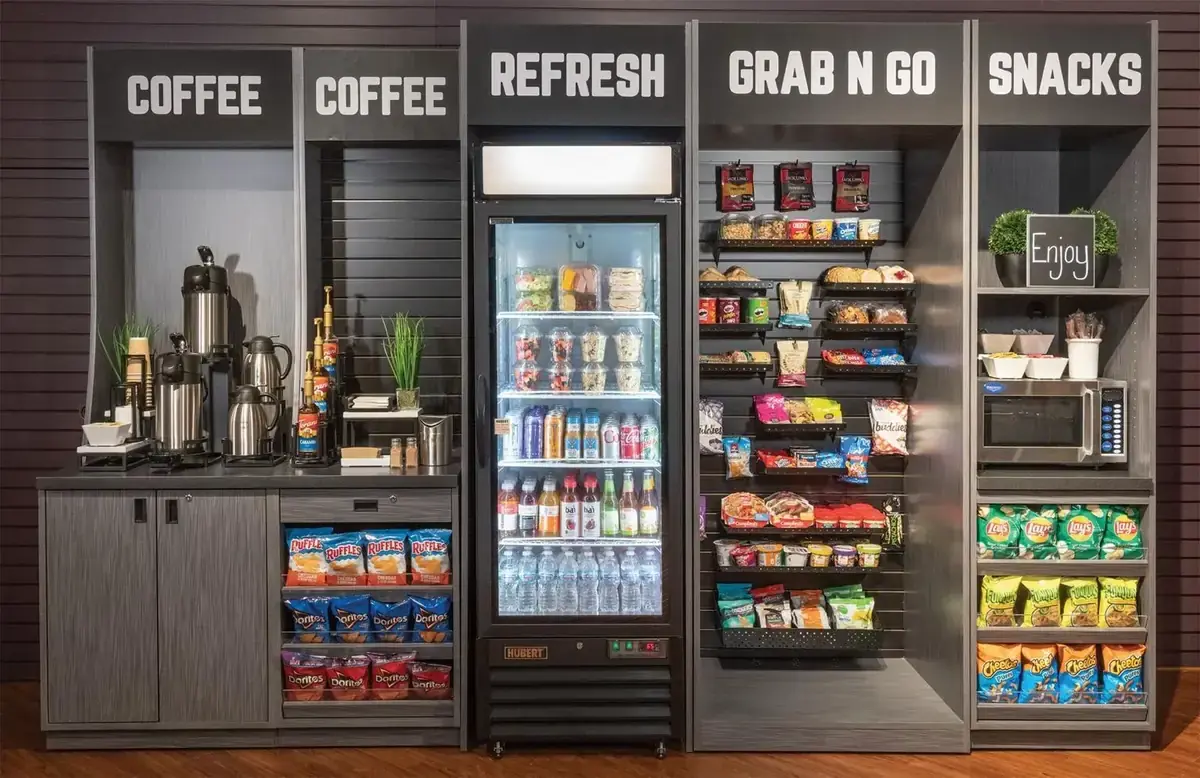
- Micro-markets that function like small self-service convenience stores with a full range of fresh and packaged options
The Micro-Market Connection:
Micro-markets are the natural evolution of fresh food vending. Instead of cramming fresh items into a traditional vending machine, a micro-market gives you open shelving, coolers, and a self-checkout kiosk. The shopping experience is completely different, and employee satisfaction with micro-markets tends to be significantly higher than with traditional machines.
Micro-markets are growing fastest in offices with 50+ employees, corporate campuses, hospitals, and large residential communities. The format works because it gives people choice, visibility, and the feeling of shopping rather than feeding coins into a box.
What This Means for Your Business:
If your workplace has the space and the headcount to support it, a micro-market is worth serious consideration. For smaller locations, modern refrigerated vending machines can still offer a meaningful fresh food selection. The key is working with a provider who has the supply chain to keep fresh items stocked and rotated properly. Fresh food that sits past its date is worse than no fresh food at all.
Trend 4: Smart Technology and Data Analytics
Connected Machines:
Modern vending machines are essentially IoT devices. They are connected to the internet, transmitting data in real time, and enabling a level of operational efficiency that was not possible even a few years ago.
What Smart Vending Technology Enables:
- Real-time inventory monitoring. The operator (and often the client) can see exactly what is in the machine at any given time, down to the individual slot.
- Predictive restocking. Instead of restocking on a fixed schedule (every Tuesday, whether the machine needs it or not), smart machines can trigger a service visit when inventory hits a certain threshold. This means fewer stockouts and more efficient service routes.
- Remote diagnostics. If a machine has a mechanical issue, the operator can often identify the problem remotely and show up with the right part, reducing downtime.
- Sales analytics. Detailed data on what is selling, when it is selling, and how payment methods break down. This information drives better product selection decisions over time.
- Dynamic pricing and promotions. Some machines can adjust pricing based on time of day or run promotions on slow-moving items, though this is still in its early stages.
The Growing Role of Data Analytics in Vending:
Data is quietly becoming one of the most important tools in vending. Good operators use sales data to continuously optimize the product mix at each location. If a particular protein bar is outselling everything else at your location, a data-driven operator will expand that category. If a product sits unsold for weeks, it gets replaced with something that will actually move.
This data-driven approach means your vending machine gets better over time. The product selection in month six should be noticeably more dialed in than the selection in month one, because real purchase data is guiding the decisions.
What This Means for Your Business:
When choosing a vending provider, ask whether they use data to optimize your product selection. Ask how they track inventory and what their response time is for stockouts or machine issues. A provider using smart technology will give you a meaningfully better experience than one still running older, disconnected equipment. For a complete rundown of the technology behind modern machines, see our payments and technology guide.
Trend 5: Sustainability Focus
Environmental Consciousness:
Sustainability in vending has moved beyond just energy-efficient machines (though that matters too). It now encompasses the full picture: the machine itself, the products inside it, and the packaging those products come in.
How Sustainability Shows Up in Modern Vending:
- Energy-efficient machines with LED lighting, smart cooling systems that reduce power consumption during low-usage hours, and Energy Star ratings
- Reduced plastic packaging as more brands shift toward recyclable, compostable, or reduced-packaging options
- Local and sustainable products when available, supporting regional brands and reducing transportation impact
- Recyclable and compostable materials including cups, wrappers, and containers in micro-market settings
- Machine longevity through better construction and regular maintenance, reducing the number of machines that end up in landfills
Consumer Expectations:
Younger employees and residents, in particular, notice and care about sustainability. A vending machine stocked with products from brands that prioritize sustainable packaging sends a positive signal about your company's or building's values. It is a small thing, but it adds up as part of a broader environmental commitment.
What This Means for Your Business:
You do not need to turn your vending machine into a sustainability statement. But choosing a provider that uses modern, energy-efficient equipment and offers products from brands with good environmental practices is a smart move. It aligns with where consumer preferences are heading and reflects well on your organization.
Trend 6: Personalization and Location-Specific Curation
Tailored Experiences:
The one-size-fits-all approach to vending is disappearing. The best vending operations now treat every location as unique, curating the product selection based on the specific people using the machine.
How Personalization Works in Practice:
- Location-specific product mixes. A tech startup gets different products than a law firm, even if both are in the same building. A gym gets different products than an apartment lobby.
- Demographic-informed selections. The product mix accounts for the age range, cultural preferences, and dietary patterns of the people at each location.
- Feedback-driven adjustments. Good operators actively solicit and respond to product requests. If your employees want a specific brand or flavor, it should show up in the machine.
- Wellness program integration. Some companies want their vending to align with corporate wellness initiatives, emphasizing nutritious options and reducing availability of sugary or highly processed products.
What This Means for Your Business:
Do not settle for a vending provider who shows up with a generic machine loaded with the same products they put everywhere. Ask how they customize the product selection for your location. Ask how they gather feedback. Ask how often they adjust the mix. The answer will tell you a lot about the quality of service you can expect.
Trend 7: Micro-Markets Growth
The Premium Option:
Micro-markets continue to be the fastest-growing segment in the vending industry, and for good reason. Grand View Research forecasts strong continued expansion in the micro-market and automated retail sectors, driven by consumer demand for variety, fresh food, and self-service convenience. They offer a dramatically better experience than traditional vending.
Why Micro-Markets Keep Growing:
- The open, self-service shopping experience feels modern and inviting, not like feeding coins into a box
- Fresh food options are much easier to offer in a micro-market format
- Product variety is far greater (often 200+ items compared to 30-40 in a traditional machine)
- Employee and resident satisfaction with micro-markets consistently outperforms traditional vending
- Self-checkout kiosks are intuitive and fast
- The visual presentation of products makes impulse purchases more likely
Where Micro-Markets Work Best:
- Offices with 50 or more employees
- Corporate campuses and business parks
- Hospitals and healthcare facilities
- Large apartment communities (200+ units)
- Hotels and conference centers
- Anywhere the client wants a premium amenity experience
What This Means for Your Business:
If you have the space and the foot traffic, a micro-market is probably the best option available today. It is a step up from traditional vending in every measurable way. If your space or headcount does not support a micro-market, modern combo or full-size machines are still excellent. But if you have been considering a micro-market and are on the fence, the trend data strongly supports making the move.
Trend 8: Touchless Everything
Post-Pandemic Permanence:
What started as a pandemic-era necessity has become a permanent consumer preference. People prefer minimal physical contact with shared surfaces, and vending machines are no exception.
How Touchless Vending Works:
- Contactless payment (tap a card or phone) eliminates the need to touch a keypad
- Some machines now allow product selection via a mobile app, so the only thing you touch is the product itself when it drops
- Antimicrobial surfaces and easy-clean materials have become standard on newer machines
- Regular cleaning and sanitizing during service visits is expected, not a bonus
What This Means for Your Business:
Touchless capability is table stakes now. If your vending provider is not offering machines with contactless payment, they are not keeping up. This is especially important in healthcare settings, gyms (where hands are sweaty), and any environment where hygiene is a priority.
How to Future-Proof Your Vending Setup
Statista projects the global vending machine market to surpass $25 billion by 2027, with smart technology and cashless capability as the primary growth drivers. If you are making a vending decision in 2026, here is a practical checklist to make sure your setup will still feel current in a few years.
Future-Proofing Checklist:
- Cashless payment capability (Apple Pay, Google Pay, card tap) is non-negotiable
- Your provider uses connected machines with real-time inventory monitoring
- The product selection includes a meaningful range of healthy options
- Your provider adjusts the product mix based on actual sales data, not guesswork
- The machine's exterior looks modern and professional, not like it was built in 2005
- Your provider is responsive, with clear communication channels and fast service response
- For larger locations, consider a micro-market now or plan for one in the near future
- Energy-efficient equipment that will not spike your electricity bill
What This All Means for Your Decision
If you are considering vending services for your workplace, apartment building, gym, or any other location, the trends above should inform your decision in a practical way. You want a provider who is already operating in line with where the industry is heading, not one who is still catching up.
Here is what to look for:
- Modern equipment with cashless payment standard
- Data-driven product selection that adapts over time
- A healthy product range alongside traditional favorites
- Responsive service with smart inventory management
- The ability to scale from a single machine to a micro-market as your needs grow
Stay Ahead with Fast Fuel
Fast Fuel Vending stays current with every trend covered in this guide. We provide modern, connected equipment with full cashless payment capability, data-driven product optimization, and a commitment to keeping your vending setup as good as it can be.
Whether you need a single combo machine for a small office or a full micro-market for a corporate campus, we build your vending around what is working now and what is coming next.
Call (321) 316-0416 for modern, forward-thinking vending service that keeps pace with the industry.